
There is a lot of information out there for runners about technique, running posture, equipment, etc.
And while all of that is meaningful information, it is not the complete story!
This is especially true when dealing with pain in the foot!
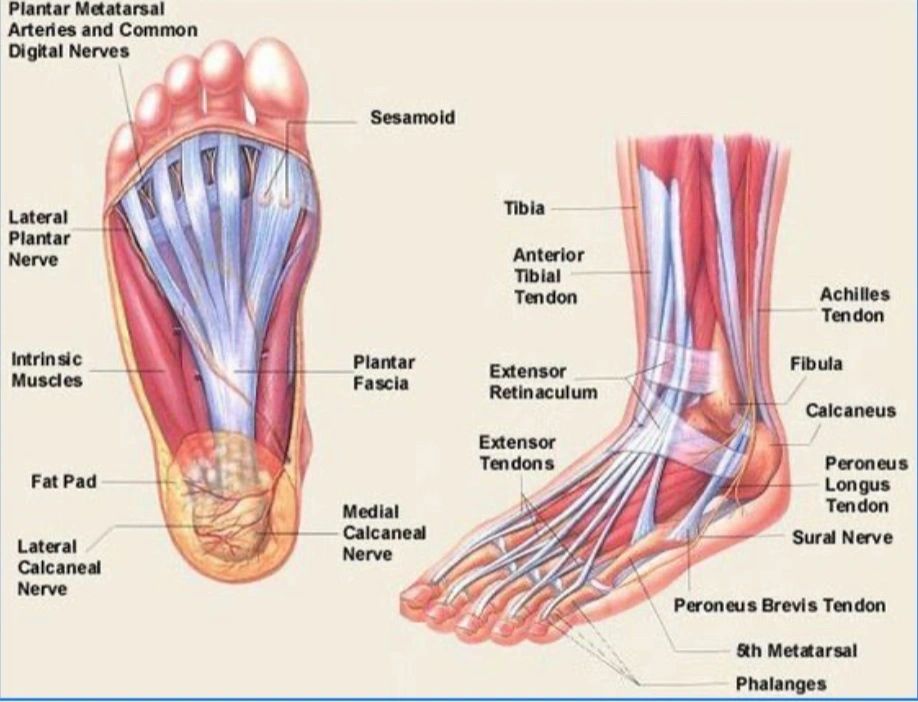
Foot pain doesn’t just happen to runners, so if you have foot pain and you don’t run, keep reading!
As you can see from the picture above, the foot is extremely complex! This results in many different causes of pain in the foot including:
- Plantar fasciitis
- Bunions
- Neuromas
Due to the complexity of the foot and ankle, there can be many different risk factors and causes of these diagnoses.
So understanding why your symptoms have started is an important part of getting rid of the pain!
While you might have heard “stretch your calf” or “try these great orthotics”, or “stop running”, often one of the key factors is missing!
The importance of understanding the mobility of the joints of your foot and ankle are often overlooked, but critically important!!
*Our foot is one of the most intricate parts of our body and there are certainly more reasons injuries can occur. Consulting a physical therapist for a comprehensive evaluation if you are experiencing pain is the best course of action.
However, there are things that you can do to get started!
Do you know which area to focus on for yourself?
Where Do I Start?
While running technique dictates where on your foot you land with each step, foot and ankle mobility will determine how efficiently your body will use the energy it needs to propel you forward for your next step.
When we don’t have enough motion in the right places, our body will still find a way to make it happen through compensations.
However, these compensations typically lead to injury over time and repetition.
So What Exactly Do We Need And Why?
Mobility!
This consists of 2 main areas:
1) How flexible are the muscles, tendons and ligaments of the foot and the ankle?
2) How well do the joints move in your ankle and toes?
These 2 things play into each other.
For example: If the calf is tight, the ankle joint it supports may not be able to move around like it is designed to as we walk and run. This over time may make the ankle more stiff.
If the ankle joint is stiff, the muscles and tendons that attach to it will not move through all of the available range it has to give. This over time causes the muscles to get tight as it doesn’t stretch with normal movement.
Result: Either way it changes how you move and decreases your mobility!
Who cares?
We do!!
Because we still want to run!
We still ask our body to accomplish the task it may not have the proper mechanics to do.
So what happens?
A different joint that does have enough motion starts to move even more than it’s supposed to.
A different muscle that is usually in a supporting role for a certain action becomes the star of the show.
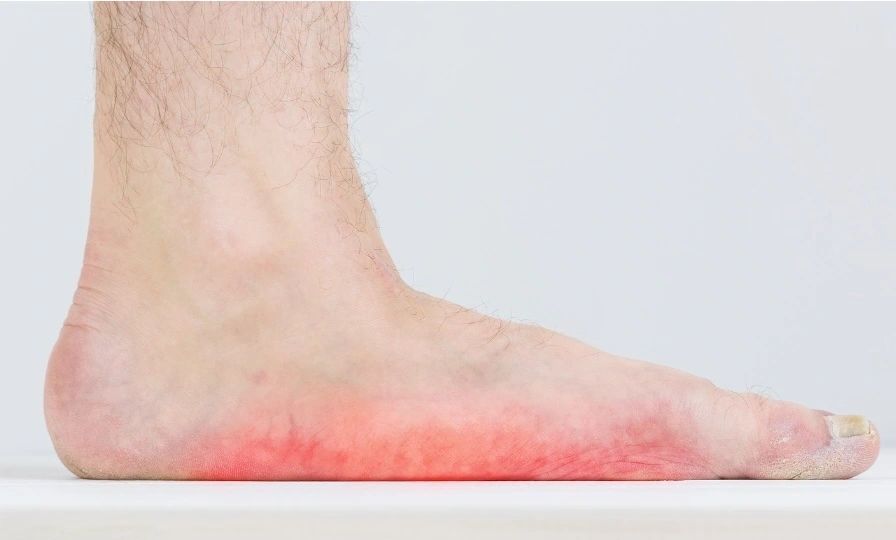
Result: We get a collapsed arch in our foot or a “flat foot.” We get tendonitis in our ankle. We get plantar fasciitis or bunions.
The list can go on…
And on….
What Causes Decreased Mobility?
There are 2 main deficits I see in the clinic leading to these types of injuries:
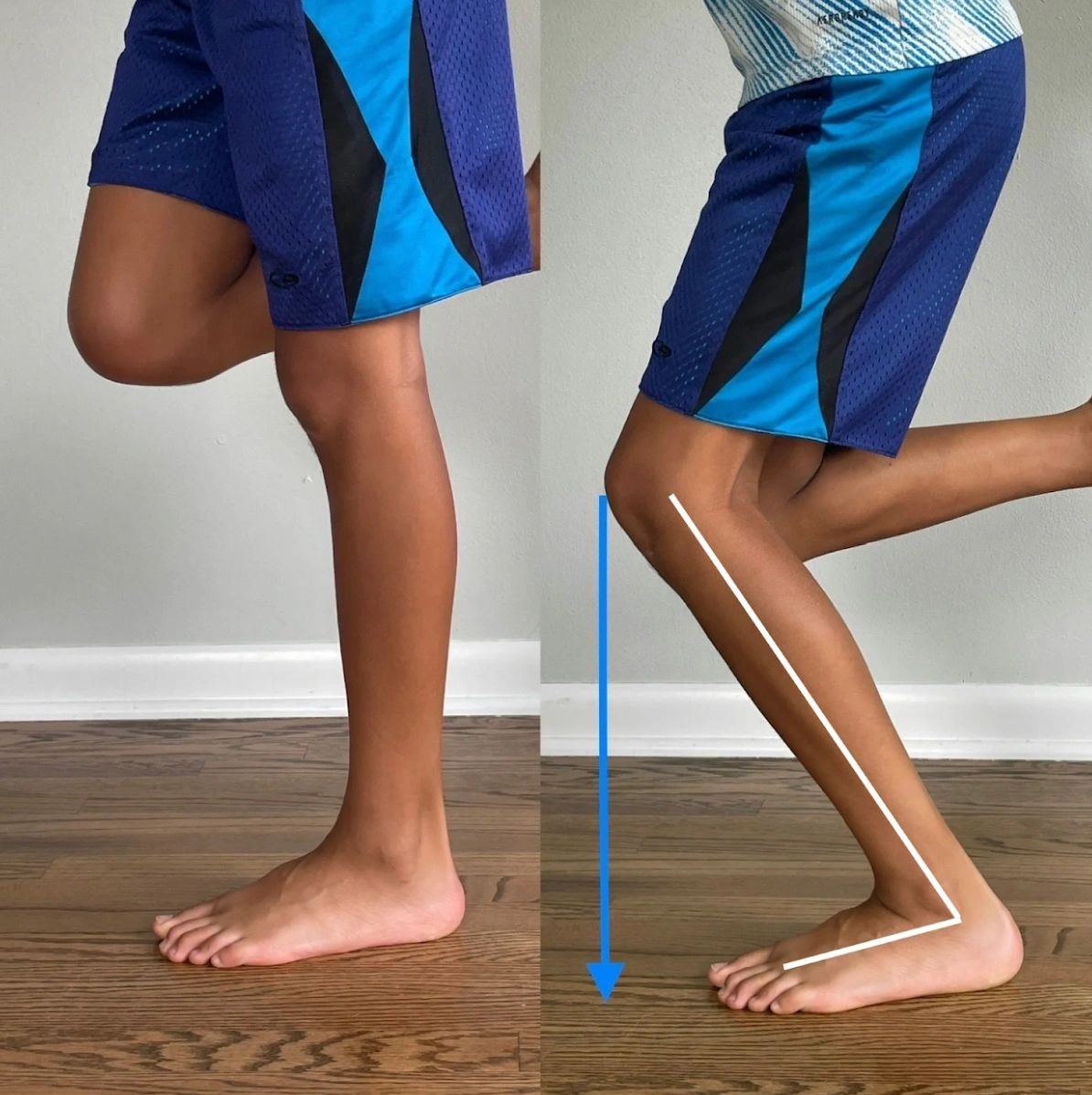
1. Limited ankle dorsiflexion [1] - with your foot flat on the ground, how far forward your shin moves over the top of your foot.
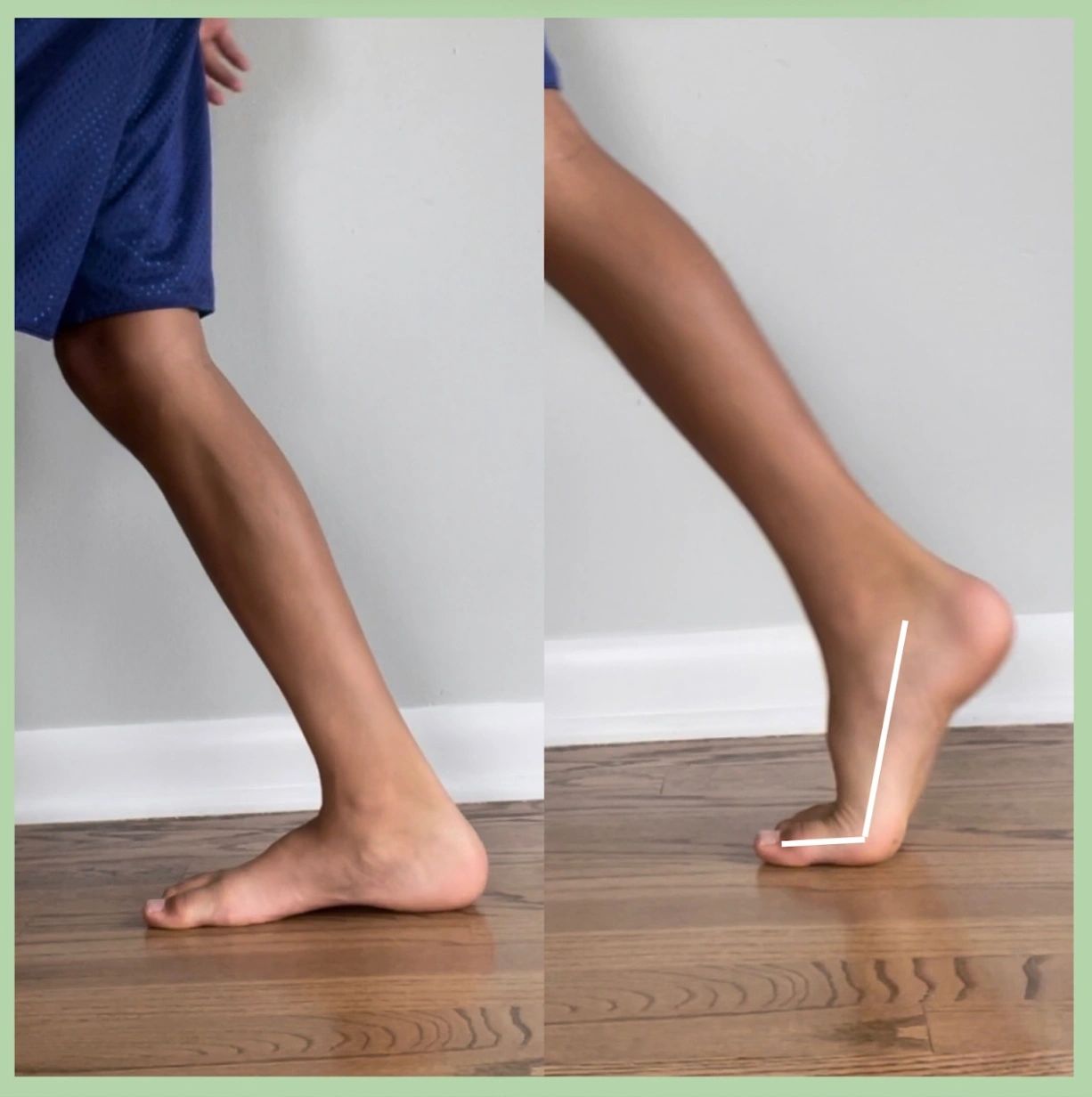
2. Limited great toe extension [2] - with your big toe flat on the ground how far your heel raises up off the ground.
2 Easy Mobility Tests:
Ankle dorsiflexion: Stand on one leg with your foot flat on the ground. Squat down so your knee bends.
Can your knee get to at least the front of your toes without your heel coming up? If not, you’ve got some work to do.
Great toe extension: Stand in a staggered stance with one foot in front of the other like you are going to take a step.
Rock your weight onto the forward foot raising your back heel off the ground. Keep your big toe flat on the ground.
Are you able to bend through the first toe enough so that the tip of your first toe would be the last thing that leaves the ground? - This is good!
Or does your foot naturally try to rock towards your outside toes?
Or do you naturally roll more towards the inside border of your big toe pushing off the whole side of the big toe rather than the tip?
If you are finding that maybe these are some areas that have some room for improvement, there are a few things you can try at home.
These Tests Were Hard! What Do I Do?
Let’s break this into our 2 types of mobility - the soft tissue structures and the joints.
Soft tissue should be addressed in 2 ways:
1. Stretching muscles:
Did you know the traditional calf stretch should be done with our knee straight AND our knee bent?
There are several muscles in our calves.
In order to address the two main muscles that form the Achilles tendon, we need to stretch in both positions.
This stretch, along with the traditional knee straight calf stretch, are better performed with a shoe on if you have flat arches to help position them correctly.
This stretch, along with the traditional knee straight calf stretch, are better performed with a shoe on if you have flat arches to help position them correctly.
The smaller muscles in our feet can be stretched by pulling your toes towards your shin or massaging your arch with a lacrosse or golf ball.
2. Lengthening tendons:
Calf raises are a great example to learn about how we can change the tension in a tendon.
We affect tendon length with the type of muscle contraction we apply to the muscle.
When a muscle contracts to overcome gravity, it’s tendon shortens.
When a muscle contracts to slow gravity down it’s tendon lengthens.
So if we want to try to decrease the stiffness in the Achilles tendon, we need to use those muscles in a way that slows gravity down.
Negative calf raises are a great tool for this
Stand on the edge of a step or a box and raise up onto your toes. Slowly lower your heel down, controlling the speed that you lower until your heel is past the edge of the step. Quickly raise back up.
Do as many as you can with your knee straight and with your knee bent.
Joint Mobilization:
A physical therapist will perform skilled manual techniques to mobilize joints most effectively, but you can also work on this on your own as well.
Consulting a professional to teach you these techniques is best.
Putting It All Together!
One of my favorite exercises for runners and people with foot pain may surprise you!
Check out this link to see an example of Walking Backwards!
We could do a whole other blog on the benefits of this exercise. But when we zoom in on the foot, it works on toe extension, ankle mobility and foot strength in a way that is very applicable to our running mechanics [3].
Give it a try on a treadmill. Start slowly and then progress to adding some incline for a real challenge!
I Need Help, What Do I Do?
If you are not quite sure how well you are moving, consult a physical therapist.
Working with runners is one of my favorite things! Running mechanics experts, like myself, can assess your mobility and strength from head to toe, perform frame-by-frame video analysis of your mechanics and keep you on the road (or trail)!
Click on your practitioner below to schedule:

If you aren’t a runner, but you have foot pain, seeking help to evaluate your movement can also help you to be pain free!
At MyPT you will receive one on one care with your PT at all times! As a small private practice, we provide what YOU need and want and help you to reach YOUR goals. We develop a relationship with our patients and are available to answer all of your questions to the best of our ability.
We are happy to discuss what options might be best for you. Contact MyPT for more information.
We believe that every person should know their physical therapist! We want to be your PT!
Click on the link below to schedule an appointment, or visit MyPT.

References
- Riddle, Daniel L. PT, PhD; Pulisic, Matthew PT, OCS; Pidcoe, Peter PT, PhD; Johnson, Robert E. PhD. Risk Factors for Plantar Fasciitis: A Matched Case-Control Study. The Journal of Bone & Joint Surgery 85(5):p 872-877, May 2003.
- Boissonnault, W., & Donatelli, R. (1984). The influence of hallux extension on the foot during ambulation. Journal of Orthopaedic & Sports Physical Therapy, 5(5), 240-242.
- Daniel J. Cipriani, Charles W. Armstrong, and Shannon Gaul. Backward Walking at Three Levels of Treadmill Inclination: An Electromyographic and Kinematic Analysis. Journal of Orthopaedic & Sports Physical Therapy 1995 22:3, 95-102